Everybody Eats
Service Design
user research / human-centred design / figma / illustrator
Problem Statement
The Everybody Eats project consisted of a team of data analysts who were looking at how they could measure food insecurity in the City of Evanston. Through this data collection they also hoped to connect food vendors with extra food with those who are food insecure.
There were multiple stakeholders to consider in order for this project to be successful. This included
the food vendors who were distributing food.
the people who are food insecure people who don’t know where to go to get the food they require.
the committees in new communities that would be setting up programs like this.
Myself and one other designer were brought onto the team on a sprint timeline of one month to explore how this information could be conveyed and how efforts like this could be replicated in other locations.
My Role
I was one of two designers on this project. As well as our work consisting of design work, it also involved explaining to other members of the team and stakeholders the value of design with work like this.
Main Learnings
With this project I had the opportunity to explore the potential of a project from very early in it’s development. I learnt:
How to jump into a project space very quickly and catch up with the work that has already been done.
How to work with other disciplines that may not be familiar with the design process and show it’s value to a project quickly.
Solutions
Food Vendors Dashboard
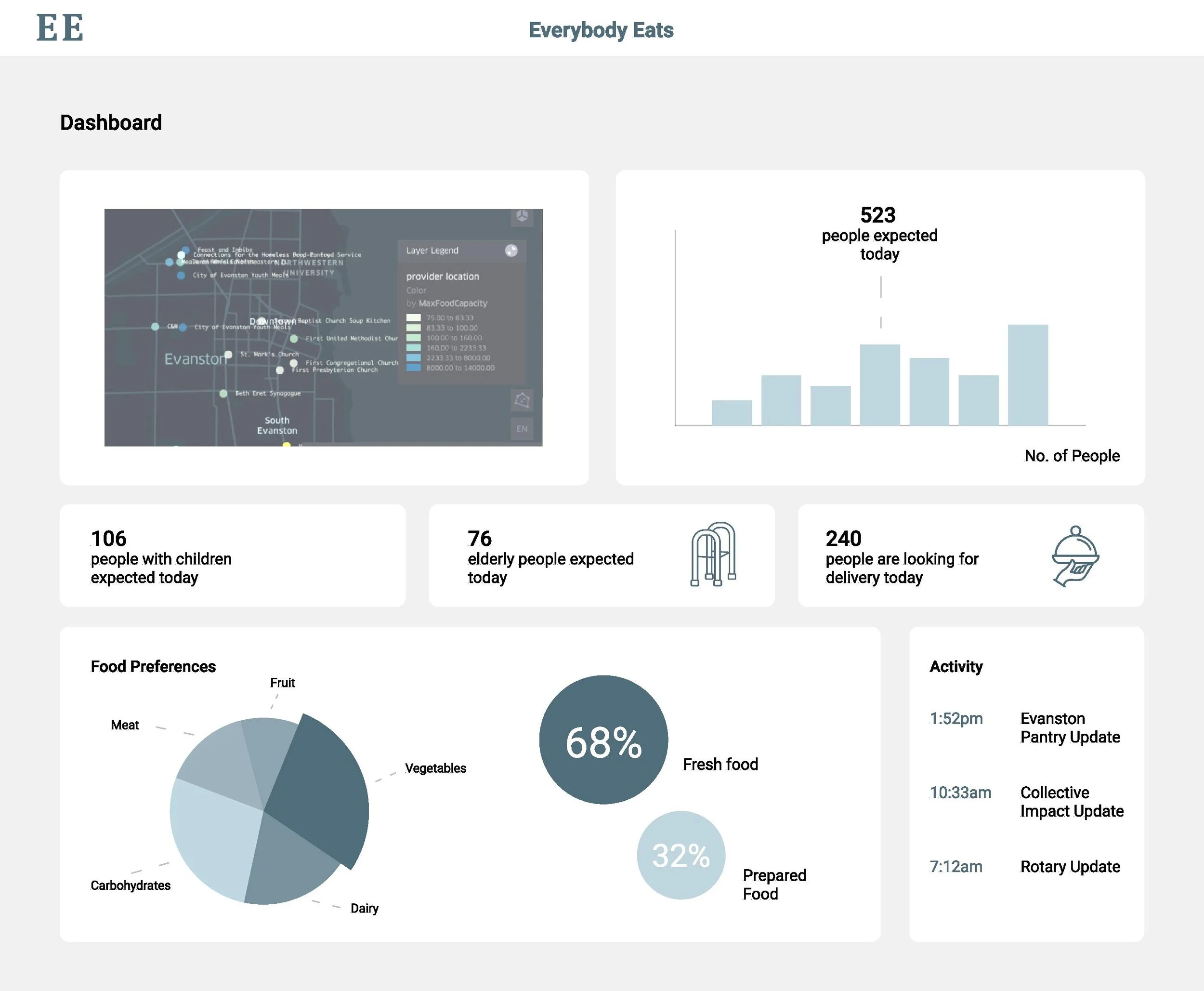
Food vendors needed a way to see clearly how many people they would be expected in a day and what these people required. This influenced the food that they brought in and the communication means that there was less food waste, which is a problem at the moment.
Chatbot
In order to gather the information for the Dashboard, we need to be in contact with the people who are food insecure. This required the design of a chatbot that included all of the data points that were requested by the data team.
We explored different ways of approaching this, including through different tones and styles.
Playbook
The aim of this program was to try it first in Evanston, with the intention to expand to other locations. So this meant that there needed to be a outline to other committees the best way to set this up and consider all parties that need to be involved in order for it to be successful. This all needed to be digested easily through a playbook.
Our work involved understanding what needed to happen at every stage and show this clearly.